
The 37th European Championships in Men's Artistic Gymnastics run from Wednesday 19 to Sunday 23 August at Arena Zagreb — the first time Croatia has hosted a European artistic championships. Forty federations, 185 senior gymnasts, thirty full teams, and a field several levels above what we just watched in Glasgow. Two things make this one bigger than a normal Euros. First, this qualification IS Europe's qualifier for the world championships in Rotterdam in October — thirteen team places and up to twenty-four individual places get handed out on Wednesday, which for most of this field is worth more than the medals. Second, this is the first European Championships since 2021 with Russia and Belarus in the building. European Gymnastics reinstated them earlier this year, flags included; then the Croatian government ruled the flags out. They compete as WG1 and WG2, and our projection has Russia winning the team title. There is also prize money, which the organisers are calling a first for a European artistic championships: EUR 150,000 across the men's and women's events, EUR 87,500 on the men's side, EUR 3,000 for winning a final down to EUR 400 for eighth, plus a coaches' fund of EUR 2,500 per final. To work out who the front runners actually are, we filtered our scores database to the official Euros entry list and pulled every score these 185 gymnasts have posted this season. Everything below comes from that data.
HOW THE WEEK WORKS
The European format is not the Commonwealth Games format, and the difference changes how you watch day one. Wednesday's qualification does three jobs at once. It decides the all-around title outright — there is no separate all-around final, the European champion is crowned on Wednesday night off qualification scores and gets his medal straight after subdivision three. It qualifies eight teams to Sunday's team final. And it qualifies eight gymnasts, max two per country, to each apparatus final. Teams are three to five gymnasts. In qualification up to four compete on each apparatus and the best three count. A team may also bring a sixth gymnast as an individual apparatus specialist on a maximum of three pieces, who does not count for the team. Sunday's team final is three up, three count — no drop score. And the subdivision draw matters this year, because unlike Glasgow the big teams are not all stacked at the end. Subdivision one (10:00) has Lithuania, Hungary, Belarus, Sweden, Ukraine, Georgia and Spain. Subdivision two (14:00) has Bulgaria, Russia, Cyprus, Norway, Israel, Armenia, Ireland, Belgium, Greece, Czechia, Portugal and Iceland. Subdivision three (17:45) has France, Netherlands, Switzerland, Turkey, Finland, Great Britain, Croatia, Slovenia, Austria, Germany and Italy. So Russia post the all-around number in the afternoon, and Britain and Croatia chase it at night knowing exactly what it is.
WHAT WEDNESDAY IS ACTUALLY WORTH
There is no standalone qualifier for the world championships — the continental championships are the qualifier, and for Europe that is Wednesday in Zagreb. Rotterdam runs 17–28 October, and worlds teams are five gymnasts. Europe gets thirteen team places. Set that against the rest of the world and the scale is obvious: Asia gets five (China, Japan, Korea, Kazakhstan and Chinese Taipei, already decided), Pan America four (Canada, Colombia, USA, Brazil), Africa one (Egypt) and Oceania one (Australia). Europe sends more than half the team field at a world championships, which is exactly why a European Championships in a worlds year carries more than its medal table suggests. Here is the number that should change how you watch: thirty nations are bringing a team to Zagreb, and thirteen of them qualify. The team final is the top eight, but ninth through thirteenth is worth just as much and nobody is filming it. When Iceland or Portugal or Austria hit a routine in a half-empty arena on Wednesday afternoon, that is a world championship place moving. On the individual side Europe gets twenty-three all-around places, plus one held for hosts the Netherlands and two further extras — twenty-six European gymnasts in total, against six each for Asia and Pan America and two each for Africa and Oceania. And here is the part that is genuinely counter-intuitive. The FIG rule is that those places go to the highest all-around gymnasts "without a team qualified", maximum two per federation. Every gymnast from the thirteen nations that have just qualified a team is struck off the individual list — they are already going. Thirteen teams of five is sixty-five men removed from the top of the ranking before a single individual place is handed out. So this does not stop at twenty-fourth. It goes far deeper. Running it on our projection, assuming the projected top thirteen teams qualify, the first individual place would land on Artur Davtyan of Armenia — seventeenth in Europe on our board. The third goes to Adam Lakomý of Czechia in 38th, the eighth to Adam Steele of Ireland in 51st, the thirteenth to Luis Lechaud of Portugal in 61st, and by the twenty-first we are at Quentin Brandenburger of Luxembourg, ranked 75th. The last European individual place at a world championships goes to somebody finishing around 75th in the all-around, not 24th. That reframes Wednesday for a lot of this field. A team can miss the thirteen and still send two gymnasts as individuals — if Czechia finish fourteenth, Lakomý and Kalinič both become eligible. The Netherlands' guaranteed host place rolls down to the next eligible European if they qualify a team, which on our projection they comfortably will. And the two extra places are a lifeline reserved exclusively for federations that qualify nothing at all — no team, no all-arounder, no apparatus specialist, one gymnast each. That is the rule that could take Kevin Crovetto, here on his own for Monaco, to Rotterdam. One caveat on those numbers: the real list is ranked off the actual all-around scores in Zagreb qualification rather than our season projection, and our database holds all-around totals for 78 of the 185 entrants, so it runs deeper still. The mechanism is exact; the names are indicative. Which raises the question we keep getting asked: does the gymnast get the spot, or does his country? The gymnast — and the team places work the opposite way round. Individual places are won by name; the regulation says these gymnasts "will qualify by name", so the man who posts the score is the man who goes and his federation cannot swap somebody else in. A team place is a country place: a nation that qualifies turns up in Rotterdam with any three to five gymnasts plus a reserve, and can rebuild that team completely between August and October. So on Wednesday, the five British gymnasts are competing for their federation. Adam Lakomý is competing for himself. The consequences are sharper than they sound. If a named individual cannot travel, his country does not keep the place — an unused all-around quota is reallocated to the next highest eligible all-arounder from the same continent, which is to say down the European ranking to another nation entirely. There is no substitute and no reserve for an individual place. An unused team place, by contrast, is not reallocated at all, though a nation unable to field its team still keeps the right to send up to two individuals. And federations have to actively confirm each place within about two weeks of being notified, with the whole reallocation chain closing 24 hours before qualification begins in Rotterdam. The other way in is the World Cup series: the top eight in the final standings on each apparatus qualify, but only to compete on the apparatus they qualified on. That is how a specialist without a team gets to a worlds. For readers closer to home: New Zealand's Alexander Istock and Daniel Stoddart have already taken Oceania's two individual places. Europe handing out twenty-four while Oceania gets two tells you plenty about the shape of this sport.
THE TEAM BATTLE
Ukraine are the defending champions — they took Rimini 2024 by three tenths over Great Britain, 255.762 to 255.429. Our projection has this one landing about the same distance apart, with two different teams at the top.
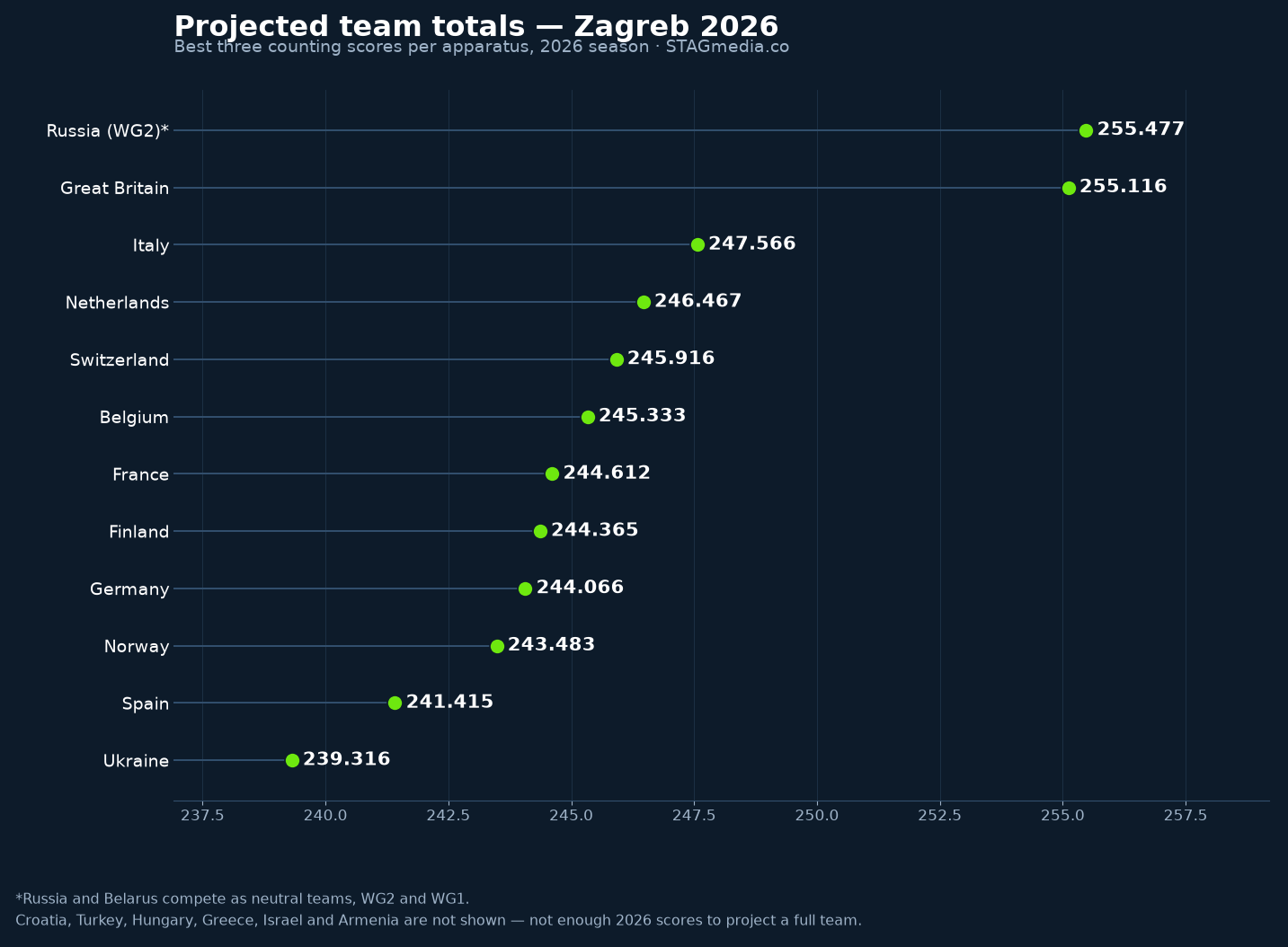
Russia project first on 255.477. Dukhno, Marinov, Sieedin, Zaika and Naidin, with Iakubov as the individual specialist, are the most complete squad on paper: the best projected parallel bars total in the championships by a full mark (44.1), and top three on floor, pommel and high bar. The soft spot is rings, where they project 41.0 to Britain's 43.6 — two and a half marks on one apparatus, which is more than the whole margin. This is also a team that has not competed together at a major since 2021, and three up three count with no drop score is not where you want to find out how that feels. Great Britain project second on 255.116, and this is the team we told you about in the Commonwealth Games preview. England sent a B team to Glasgow because they were prioritising this meet — here is where the A team went. Tulloch, Hepworth, Fraser, Rushworth and Scott, with Jack Stanley as the individual. Joe Fraser owns the biggest all-around score in the entire field, Harry Hepworth is top four on floor, rings and vault by himself, and Britain project best in the championships on both rings (43.6) and vault (43.8). Any Russian wobble and this is Britain's title. Italy project third on 247.566 and are the best of the rest by a clear mark — Abbadini in the all-around and on high bar, Targhetta with the biggest pommel score in the field, Speranza on floor. Their weakness is parallel bars, where they project bottom of the top eight. Then it tightens right up: Netherlands 246.467, Switzerland 245.916, Belgium 245.333, France 244.612, Finland 244.365, Germany 244.066, Norway 243.483, Spain 241.415, Ukraine 239.316. Nine teams inside seven marks fighting for the last five team-final places, with the defending champions sitting twelfth on projection after a heavy squad turnover. One honest caveat, the same one we gave for Cyprus at the Commonwealth Games. Some teams cannot be projected because their gymnasts have not posted enough international scores this season: Croatia, Turkey, Hungary, Greece, Israel and Armenia among them. Several of those are realistically top eight — Turkey have Arican and Asil, Hungary have Meszaros, Croatia are at home with Kovtun and Srbic. Their absence from the chart is a gap in the data, not a prediction. Our pick: Russia, Great Britain, Italy — with rings as the lever that could flip the top two.
ALL-AROUND
Decided on Wednesday, off qualification, with no second chance. Joe Fraser leads the entry list on 84.500 from British championships in March and is the only man in the field over 84 — a score that would sit top five in the world this season.
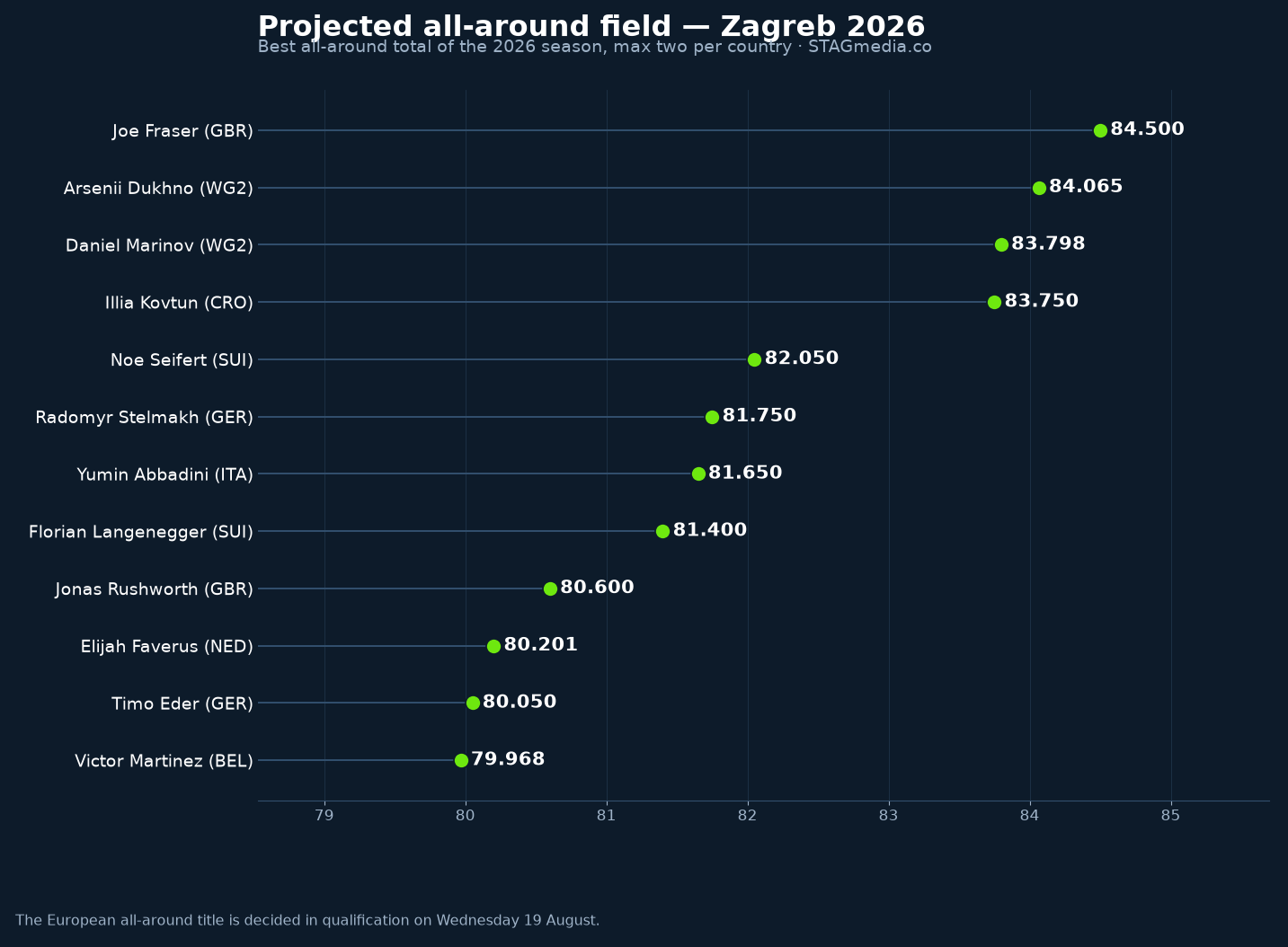
Four men sit within eight tenths at the top: Fraser 84.500, Arsenii Dukhno 84.065, Daniel Marinov 83.798 and Illia Kovtun 83.750. That is the medal fight. Kovtun is the story of the week. He won parallel bars silver in Paris for Ukraine, switched his sporting nationality to Croatia in 2025, and only became eligible to compete internationally for them in July — so his first major as a Croatian is a European Championships in Zagreb, in front of a home crowd. Behind the front four: Noe Seifert 82.050, Radomyr Stelmakh 81.750, Yumin Abbadini 81.650, Florian Langenegger 81.400. The two-per-country rule bites Russia and Switzerland but does not squeeze anyone major out. The wild card is the man who won it last year. Adem Asil took the Leipzig title on 82.398, and his best all-around of 2026 is 76.900 — he has been almost entirely a rings specialist this season. If he arrives in all-around shape it reshapes the top of this list. Krisztofer Meszaros, last year's bronze medallist, sits 24th on our board at 78.331, but Hungarian scores are thin in the database, so treat that as a floor rather than a ceiling.
FLOOR
Projected winner: Arsenii Dukhno (WG2) — best score 14.750. Top difficulty: Harry Hepworth (GBR), 6.1.
| # | Highest scores | Highest D-scores |
|---|---|---|
| 1 | Arsenii Dukhno (WG2) 14.750 | Hepworth (GBR) 6.1 |
| 2 | Artem Dolgopyat (ISR) 14.566 | Dukhno (WG2) 5.9 |
| 3 | Yahor Sharamkou (WG1) 14.533 | Dolgopyat / Sharamkou / Stanley 5.8 |
Luke Whitehouse has won this three years running and he is not here — Britain sent him to Glasgow instead — so the floor title is genuinely open for the first time in years. Artem Dolgopyat is the name to watch: the Olympic champion gives away three tenths of difficulty to Dukhno and makes almost all of it back on execution at 8.766. Hepworth brings the biggest routine in the field at 6.1 but has been executing around 8.4, so he needs a clean one. And watch Aurel Benovic on 14.100 — a home floor final in Zagreb.
POMMEL HORSE
Projected winner: Gabriele Targhetta (ITA) — best score 15.000. Top difficulty: Edoardo De Rosa (ITA) and David Ivanov (BUL), 6.0.
| # | Highest scores | Highest D-scores |
|---|---|---|
| 1 | Gabriele Targhetta (ITA) 15.000 | De Rosa (ITA) / Ivanov (BUL) 6.0 |
| 2 | Mamikon Khachatryan (ARM) 14.966 | Targhetta (ITA) / De Munck (NED) / Kovtun (CRO) 5.9 |
| 3 | Hamlet Manukyan (ARM) 14.866 | Khachatryan (ARM) 5.8 |
The best final of the championships: a 15.0 leading it and five men over 14.6. Armenia went one-two here in Leipzig and both are back, and they can only take those two. Loran de Munck (14.650) is quietly excellent and doubles as the Dutch team's anchor. The one everybody will be watching is Rhys McClenaghan. The Olympic champion is entered as Ireland's individual specialist, and his best pommel score of 2026 is 14.100 — which on this projection is outside the final. He is still working back from surgery. If the real routine turns up on Wednesday, this final becomes ridiculous.
RINGS
Projected winner: Artur Avetisyan (ARM) — best score 14.900. Top difficulty: Hepworth, Tulloch and Zaika, 5.7.
| # | Highest scores | Highest D-scores |
|---|---|---|
| 1 | Artur Avetisyan (ARM) 14.900 | Hepworth (GBR) / Tulloch (GBR) / Zaika (WG2) 5.7 |
| 2 | Harry Hepworth (GBR) 14.850 | Asil (TUR) / Petrounias (GRE) 5.6 |
| 3 | Courtney Tulloch (GBR) 14.600 | Sahakyan (GER) 5.3 |
The deepest quality final of the meet. Adem Asil and Eleftherios Petrounias tied for gold here last year and both are back, projected fifth (14.533) and sixth (14.466) — and every one of these is another title on the biggest rings pile Europe has produced. Ilia Zaika ties Tulloch on 14.600. Britain having two men in the top three is exactly why they project best in the field on rings, and why this is their route to team gold. Our pick is Avetisyan, who took bronze last year and leads the season, but any of the top six would be unsurprising.
VAULT
Projected winner: Nazar Chepurnyi (UKR) — best two-vault average 14.716. The vault final is two vaults averaged, so this is the one event where the single-vault board misleads you. Everything here is the best pair each man has put down at one meet this season.
| # | Two-vault average | Vault 1 / Vault 2 |
|---|---|---|
| 1 | Nazar Chepurnyi (UKR) 14.716 | 14.766 / 14.666 |
| 2 | Artur Davtyan (ARM) 14.666 | 14.666 / 14.666 |
| 3 | Harry Hepworth (GBR) 14.616 | 14.733 / 14.500 |
| 4 | Sol Scott (GBR) 14.425 | 14.700 / 14.150 |
| 5 | Arsenii Dukhno (WG2) 14.366 | 14.400 / 14.333 |
Fifty thousandths separate the top two. Artur Davtyan is the defending champion who has essentially owned this event for years, and his pair is the frightening one: 14.666 and 14.666, two identical vaults with no weak second. Chepurnyi leads on average but drops a tenth on his second, so Davtyan does not need to out-vault him — he just needs Chepurnyi's second one to be ordinary. Look at how much that second vault decides. Harry Hepworth has the biggest single vault of the three leaders at 14.733 and sits third because his second is 14.500. Sol Scott has a 14.700 first vault and a 14.150 second, which is the difference between a medal shot and fourth. Sebastian Sponevik is the tidiest profile in the field — 14.200 and 14.200, no drop-off at all — and that is exactly the shape that steals a podium if the leaders miss.
PARALLEL BARS
Projected winners: Joe Fraser (GBR) and Illia Kovtun (CRO), tied on 14.800. Top difficulty: Kovtun, 5.8.
| # | Highest scores | Highest D-scores |
|---|---|---|
| 1 | Fraser (GBR) / Kovtun (CRO) 14.800 | Kovtun (CRO) 5.8 |
| 2 | Marinov (WG2) / Dukhno (WG2) 14.733 | Marinov (WG2) / Arican (TUR) / Seifert (SUI) 5.7 |
| 3 | Ferhat Arican (TUR) 14.533 | Dukhno (WG2) / Fraser (GBR) 5.6 |
Four men inside seven hundredths — the best head-to-head of the championships. Kovtun won this in Rimini in 2024, brings the biggest routine in the field, and is at home. Fraser matches him on score with two tenths less difficulty, which tells you exactly how well he executes it. Ferhat Arican is a former European champion here and still swinging 5.7. Note the gap in the data: Nils Dunkel won this title last year and has no parallel bars score in our 2026 database at all. He is on the German entry, and if he is fit he is a medal chance the projection cannot see.
HIGH BAR
Projected winner: Joe Fraser (GBR) — best score 14.533. Top difficulty: Fraser, 6.2 — the biggest D score of any routine in the championships.
| # | Highest scores | Highest D-scores |
|---|---|---|
| 1 | Joe Fraser (GBR) 14.533 | Fraser (GBR) 6.2 |
| 2 | Tin Srbic (CRO) 14.400 | Kovtun (CRO) 5.8 |
| 3 | Illia Kovtun (CRO) 14.350 | Kilicer (TUR) / Abbadini (ITA) 5.7 |
This is the final we are most excited for. Tin Srbic is the 2017 world champion on high bar — the first Croatian ever to win a world gymnastics title — plus Tokyo Olympic silver and two European silvers on the piece. And he is Croatian, in Zagreb, at a home European Championships. If one moment this week makes an arena lose it, this is the one. Fraser has the bigger routine by four tenths and the better season score, so on paper he is the pick, but Srbic executes at 8.700 and knows exactly what a home final feels like. Savelii Sieedin, Mert Efe Kilicer and Yumin Abbadini are all tied on 14.200 behind them. Same asterisk as parallel bars: Robert Tvorogal of Lithuania won this last year and has no 2026 high bar score in our data.
BEYOND THE MEDALS
The neutral teams are the structural story, and the order of events matters more than the headline. European Gymnastics lifted all sanctions on Russian and Belarusian athletes at its Congress in May, following the World Gymnastics decision, with a transitional approach signed off by an Extraordinary General Assembly on 28 July — reinstated as nations, flags included. Three days later Croatia's Ministry of Tourism and Sport, as the competent government authority, applied every measure on the non-use of Russian and Belarusian flags, anthems, national symbols and national identifiers at these championships, and European Gymnastics said it respects that decision. The confirmed conditions: the World Gymnastics flag in place of the national ones, neutral music instead of anthems, no use of the names Russia or Belarus or the codes RUS and BLR anywhere in scoring, results, accreditation or television graphics, and no national colours or emblems on kit. Hence WG1 for Belarus and WG2 for Russia. So this is not the sport sanctioning them — the sport let them back in with flags, and the host country took the flags away. There was a visa fight too: nine of the sixty-five-strong Russian delegation were initially refused entry, and on the women's side Viktoria Listunova was denied outright while Angelina Melnikova was refused and then approved. As of 10 August European Gymnastics say the majority of the Russian delegation have their visas and will arrive in time for podium training. On the floor, Russia are projected to win the team title and hold two of the top three all-around scores. Belarus are harder to read — their gymnasts have barely competed internationally this season — though Yahor Sharamkou projects third on floor. And then there are the countries you rarely see on a stage this size. Denmark, Monaco, Serbia and Slovakia are each sending exactly one senior gymnast; Latvia, Luxembourg, Poland and Romania have two. They get folded into mixed groups in qualification, and they are some of the most fun watching of the week — Dmitrijs Mickevics of Latvia is genuinely good on pommel horse at 14.166, and Kevin Crovetto is carrying Monaco on his own. Croatia could have the best week in their federation's history in their own arena: Kovtun and Srbic both project as medallists, with Benovic on floor and Filip Ude alongside them. And there is a comeback watch running all week — McClenaghan on pommel, Asil in the all-around, Dunkel and Tvorogal missing from our data entirely. Four defending or former champions whose current form we genuinely cannot see, and qualification day answers all of it. That is the full preview. Every projection comes from our database filtered to the official European Gymnastics entry list, and you can pull up the Euros 2026 form guide on our scores board yourself. Tell us your podiums in the comments, and come watch the finals with us on STAG+.
Comments
Discussion
No comments yet.
Sign in with your STAG account on the membership page to join the discussion.